


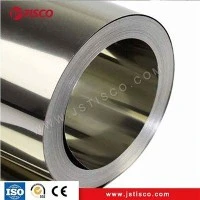


As a supplier of 304 Stainless Steel Coil, I often get asked about the weight of 304 stainless steel coil per square meter. This is a crucial question for many customers, especially those in construction, manufacturing, and other industries that rely on accurate material calculations. In this blog post, I'll delve into the factors that determine the weight of 304 stainless steel coil per square meter and provide you with the necessary information to make informed decisions.
Understanding 304 Stainless Steel
Before we calculate the weight, it's essential to understand what 304 stainless steel is. 304 stainless steel is one of the most commonly used grades of stainless steel. It contains approximately 18% chromium and 8% nickel, which gives it excellent corrosion resistance, formability, and strength. These properties make 304 stainless steel suitable for a wide range of applications, from kitchen appliances to architectural structures.
Factors Affecting the Weight of 304 Stainless Steel Coil
The weight of 304 stainless steel coil per square meter is primarily determined by two factors: the thickness of the coil and the density of 304 stainless steel.
Thickness
The thickness of the 304 stainless steel coil plays a significant role in determining its weight. Thicker coils will naturally weigh more per square meter than thinner ones. The thickness of stainless steel coils can vary widely, from very thin foils to thick plates. Common thicknesses for 304 stainless steel coils range from 0.3mm to 6mm, but they can be manufactured in other thicknesses as well.
Density
The density of 304 stainless steel is another crucial factor. The density of 304 stainless steel is approximately 7.93 g/cm³. This value is used in the calculation to determine the weight of the coil per square meter.


Calculating the Weight of 304 Stainless Steel Coil per Square Meter
The formula to calculate the weight of 304 stainless steel coil per square meter is as follows:
Weight (kg/m²) = Thickness (mm) × Density (g/cm³) × 1
Let's break down the formula and understand how it works.
- Thickness (mm): As mentioned earlier, the thickness of the coil is measured in millimeters. You need to know the exact thickness of the 304 stainless steel coil you are using.
- Density (g/cm³): The density of 304 stainless steel is 7.93 g/cm³. This value remains constant for 304 stainless steel.
- Conversion factor: Since the density is in g/cm³ and we want the weight in kg/m², we need to convert the units. 1 cm³ is equal to 1000 mm³, and 1 m² is equal to 1,000,000 mm². So, when we multiply the thickness in mm by the density in g/cm³, we get the weight in grams per square millimeter. To convert it to kg/m², we divide by 1000 (to convert grams to kilograms) and multiply by 1,000,000 (to convert square millimeters to square meters), which simplifies to multiplying by 1.
Let's take an example to illustrate the calculation. Suppose we have a 304 stainless steel coil with a thickness of 2mm. Using the formula, we can calculate the weight per square meter as follows:
Weight (kg/m²) = 2mm × 7.93 g/cm³ × 1 = 15.86 kg/m²
So, a 304 stainless steel coil with a thickness of 2mm weighs approximately 15.86 kg per square meter.
Importance of Knowing the Weight
Knowing the weight of 304 stainless steel coil per square meter is essential for several reasons.
Cost Estimation
When purchasing 304 stainless steel coils, the cost is often calculated based on the weight. By knowing the weight per square meter, you can accurately estimate the cost of the material for your project. This helps you budget effectively and avoid overspending.
Structural Design
In construction and manufacturing, the weight of the material is a critical factor in structural design. Engineers need to know the weight of the 304 stainless steel coil per square meter to ensure that the structure can support the load. This information is used to determine the appropriate size and strength of the supporting elements.
Transportation and Handling
The weight of the 304 stainless steel coil also affects transportation and handling. Heavier coils require more robust transportation methods and handling equipment. Knowing the weight per square meter helps in planning the logistics and ensuring the safe and efficient movement of the material.
Our Offerings
As a supplier of 304 Stainless Steel Coil, we offer a wide range of products to meet your specific needs. Our 304 Stainless Steel Coils are available in various thicknesses, widths, and lengths. We also offer Stainless Steel Strip 304 and Stainless Steel Coil Strip for more specialized applications.
Our products are manufactured using high-quality materials and advanced production techniques to ensure superior quality and performance. We also provide excellent customer service and technical support to help you choose the right product for your project.
Conclusion
In conclusion, the weight of 304 stainless steel coil per square meter is determined by the thickness of the coil and the density of 304 stainless steel. By using the formula provided in this blog post, you can easily calculate the weight per square meter for your specific application. Knowing the weight is crucial for cost estimation, structural design, and transportation and handling.
If you are in need of 304 stainless steel coils or have any questions about our products, please feel free to contact us. We are here to help you find the right solution for your project.
References
- ASM Handbook, Volume 13A: Corrosion: Fundamentals, Testing, and Protection
- Stainless Steel World Magazine
- The Nickel Institute