


Carbon Steel
Your Trustworthy Carbon Steel Manufacturer!
Jiangsu Tisco Metal Co., Ltd Is Located In Jiangsu Province Wuxi City, The Large South stainless Steel Markets In China, Is Also One of the Powerful Company In the alloy Steel, carbon steel, stainless steel Area With Large Scale.JiangSu Baosteel Metal Product Co., Ltd is a professional engaged in precision alloy, superalloy, nickel-based special welding wire, corrosion resistant alloy and other high-performance alloy materials independent production and research and development of enterprises, private science and technology enterprises in Jiangsu Province, science and technology enterprises in Jiangsu Province, staff entrepreneurship base.




Why Choose Us
Our Certificate
The Our company quality system has passed SGS, ISO9001:2015 standard certification.
Our Service
Competitive prices; Quality service attitude; Professional technical team; High quality control each link, 2 years quality assurance.
Production Equipment
Our company has advanced Equipment Using In Slitting, Cutting In horizontal, Laser Cutting, Plasma And Grinding Machine And Embossing Machine
Products Widely Used
Our products are widely used in decoration, medical, food, construction and other industries, and have received good customer feedback and established a good relationship of mutual trust with our customers.
Product Description
|
Product Name: |
Carbon Steel Round Bar |
|
Material: |
Alloy tool steel |
|
Tolerance: |
±1% |
|
Standard: |
China DIN standard |
|
Place of origin: |
China |
|
Alloy or not: |
Alloy |
|
Delivery time: |
8-14 days |
|
Production Process: |
Hot Rolling |
|
Processing Service: |
Cutting, Punching, Turning |
|
Length: |
Customised |
Types Of CarBon Steel
Low-CarBon Or Mild Steel
Due to the fact that low-carbon steels cannot be hardened by heat, the metal is usually treated by cold work. Furthermore, the material shows low tensile strength and hardness, though the mechanical properties can be improved through carburizing. On the other hand, low-carbon steels show high ductility, toughness, are cheap and easy to form. They are characterized by a carbon content of less than 0.25% by weight. Low-carbon steel is the most widely used grade. In Addition, it is also known as mild steel.
MediUm-CarBon Steel
Medium-carbon steel is characterized by a martensitic microstructure, which is achieved through heat treatment followed by quenching and tempering. The amount of carbon ranges between 0.25 – 0.65% by weight. Further, the manganese content lies between 0.60 – 1.65% by weight.
High-CarBon Steel
The amount of carbon in such steels ranges from 0.60 – 1.25% by weight. These steel grades show the highest hardness and toughness of all steel grades. Furthermore, they have the lowest ductility. In most cases, high-carbon steels are hardened and tempered. As a result, they are very wear resistant. This makes high-carbon steel perfect for the production of cutting tools.

Advantages of Carbon Steel
Durable – Carbon steel is extremely strong and shock resistant. This makes it a popular choice for construction, piping and to support modern roads. This type of steel is also not prone to rotting as many other metals are.
Safe -Compared to many other materials, steel is safe to handle and work with. It’s also a good material for building homes that are resistant to fires, hurricanes, tornadoes and earthquakes.
Green -Carbon steel is easy to recycle compared to many other materials, making it environmentally friendly.
Economical -For many uses, such as piping, carbon steel can be made very thin compared to other metals. This makes it very cost effective. Carbon steel pipes, for example, are cheaper to make than copper pipes.
Healthy and Long Lasting For Cookware -Pots and pans made with carbon steel are healthy to cook with. Aluminum cookware can react with foods and potentially cause health problems. Carbon steel cookware also lasts longer than aluminum and is less prone to dents and scratches. Finally, carbon steel heats up very fast.
Finishing Processes for Carbon Steel
Product Rolling Solid cast ingots must be rolled into more useful shapes and sizes like those produced by continuous casting. Steel is compressed and pulled by rotating rolls. The rolls rotate at a faster pace than the steel as it enters the machine, therefore thrusting the steel forward and compressing it.
Hot Forming Steel is heated above the recrystallization temperature to break up the as-cast microstructure. This yields a more uniform grain size and even distribution of carbon within the steel.
Cold Forming Cold forming is carried out below the recrystallization temperature. This process increases the strength through strain hardening by up to 20%, while improving the finish and allowing tighter tolerances. Steel emerges from the rolling process as semi-finished products in the form of blooms, billets, or slabs, depending on the final dimensions.
Heat treating The purpose of heat treating steel is to manipulate its mechanical properties by changing the distribution of carbon in the product and the internal microstructure. When manipulating the mechanical properties of steel, an increase in ductility results in a reduction of hardness and strength and vice versa.
Surface treating Approximately one third of steel produced is treated with a surface coating to inhibit corrosion and improve weldability.
Hot dip galvanizing Galvanizing is a process of applying a zinc surface coat to steel. The steel is heated before entering a zinc bath, where liquid zinc layers the surface of the product. The thickness of the coating is controlled with gas-knives.
Electrolytic galvanizing Another process for applying a zinc coat to steel products is through electrolytic galvanizing. Zinc is deposited onto the surface of the steel by controlling the current in an electrolyte solution. This technique allows for better control of the coating thickness.
Application of Carbon Steel

years
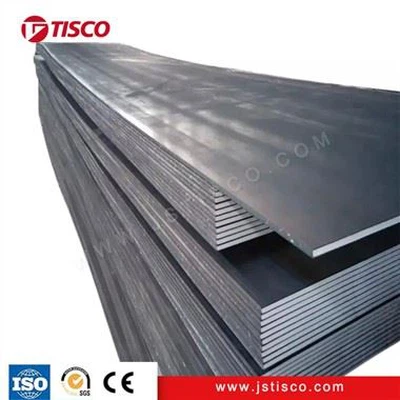
In the manufacturing industry, carbon steel plates are often used as a base material for the building of components. It is because its durability makes it an ideal choice for manufacturing bolts, gears, and screws, among others. When a carbon steel plate is used for these components, machines operate for longer before needing replacement gears or screws.
Construction
In construction, you’ll usually find that carbon steel plates are used in the building of ships and bridges, as well as other types of commercial or industrial buildings. Due to their strength, the carbon steel plates can be used for different types of braces or brackets, which are integral to the overall construction. They may also be used for base plates that provide anchoring support.
Storage Tanks
Carbon steel plates are also used to make storage tanks. This type of metal responds to riveting really well, and it can be welded properly to create a tank that’s water-resistant and airtight. Additionally, it’s a more cost-effective option that allows you to make a tank for a cheaper cost without compromising quality.
FAQ
We're professional carbon steel manufacturers and suppliers in China, specialized in providing high quality custom service and OEM service. We warmly welcome you to wholesale carbon steel for sale here from our factory. For price consultation, contact us.